

To understand Lib Mason’s current paintings, it helps to trace the long professional road that led to them, a path that runs from editorial illustration classrooms to magazine pages to licensed product lines, before finally arriving, roughly eight years ago, at an independent oil-painting practice built on centuries-old technique.
Foundations at RISD
Mason’s formal training began at the Rhode Island School of Design, where she studied editorial illustration, a discipline focused on producing images that communicate clearly and quickly, often on tight deadlines and for a specific publication’s needs. That training set the technical and conceptual foundation for everything that followed: an eye for composition, a facility with narrative imagery, and an understanding of how to hold a viewer’s attention.
A Career in Commercial Illustration
From there, Mason built a career as a commercial illustrator, creating work for major publications including Rolling Stone and Time Life Warner. This period of her career required range, the ability to shift visual approach depending on the publication, the article, and the audience, as well as the discipline to deliver polished work within a client’s timeline and vision rather than her own.
Expansion Into Product and Licensing
Mason’s commercial practice didn’t stay confined to editorial work. Over time, it expanded into product development and several artist-branded licensed lines, extending her imagery beyond the page and into consumer goods carrying her name and visual style. This phase of her career reflects a different set of skills entirely, translating illustrative work into branded products, likely requiring collaboration with manufacturers, licensors, and business partners in addition to the creative work itself.
Stepping Away
Roughly eight years ago, Mason retired from commercial work. For an artist whose entire professional identity had been built around client needs, publication deadlines, and licensing agreements, that departure created an unusual kind of opening: for the first time, nothing external was dictating what she should make next. Her own account of this period frames it as a genuine question rather than an obvious next step, what would she paint when no client, assignment, or commission was steering the subject?
Building a New Practice
The answer took shape as a return to painting, but not a return to anything resembling her earlier commercial work. Mason committed to oil painting using the Flemish technique, a historical Old World method entirely distinct from the fast-turnaround demands of editorial illustration. Each painting now begins with a grisaille, a monochrome underpainting that establishes form, value, and light. From there, she builds the image through multiple transparent glazes, letting color and luminosity develop gradually, a process that rewards patience over speed, a notable departure from the pace her earlier career would have demanded.
Her subject matter shifted just as significantly as her technique. Rather than illustrating assigned topics for a publication or developing broadly marketable imagery for licensed products, Mason turned her new practice toward contemporary political, social, and environmental concerns, sourced entirely from her own interests rather than any outside brief. Her stated approach avoids literal illustration of these events in favor of beauty, symbolism, humor, and absurdity, tools that let her invite a viewer in before revealing a painting’s actual subject.
The Body of Work That Followed
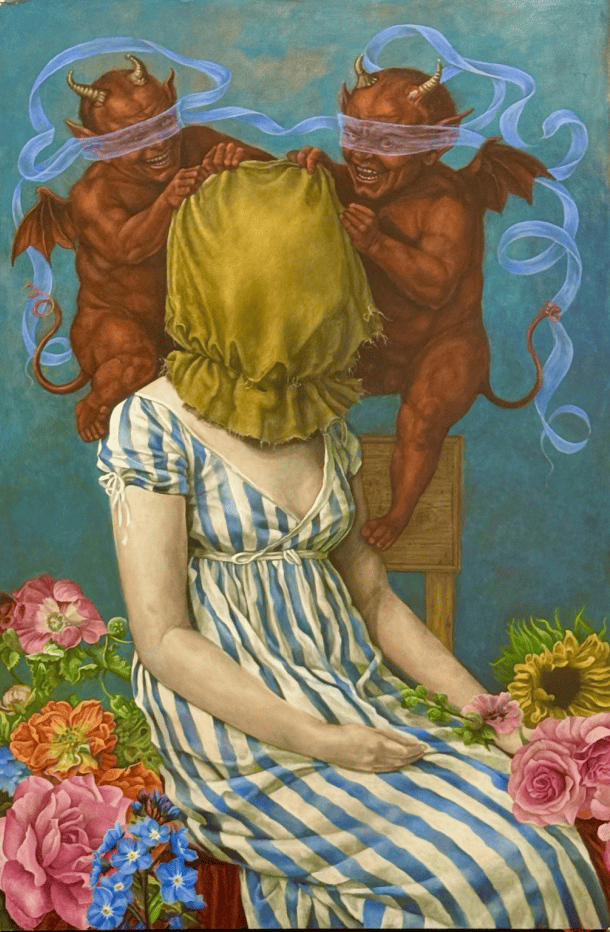
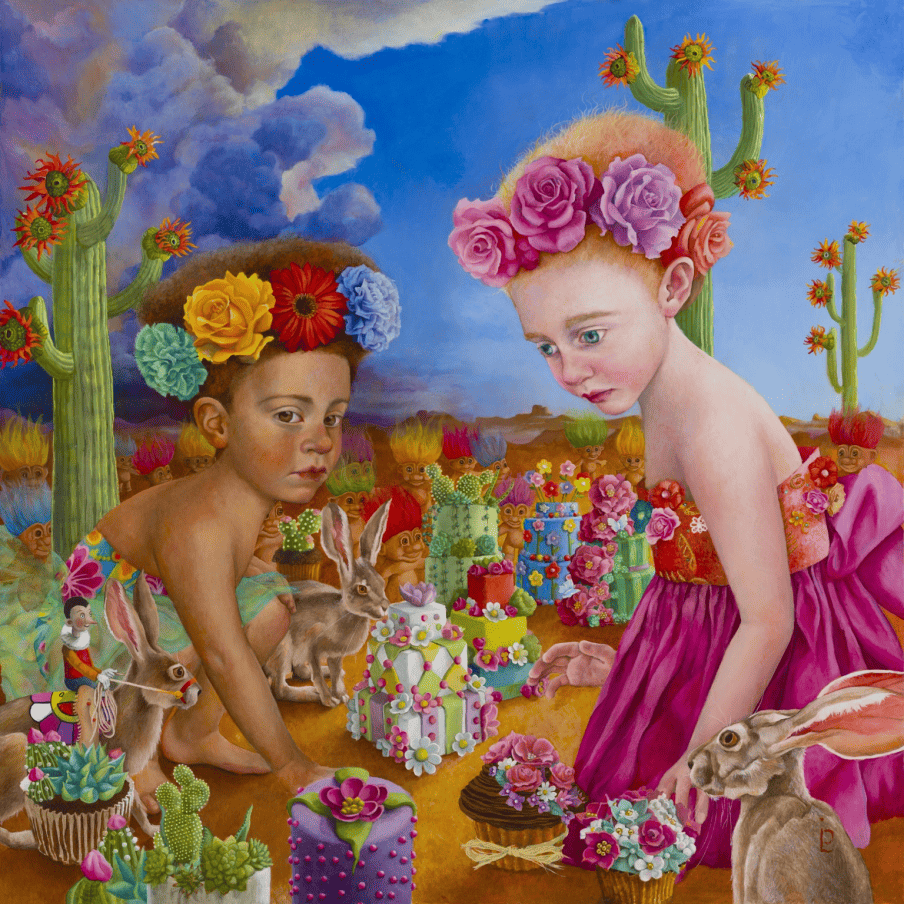
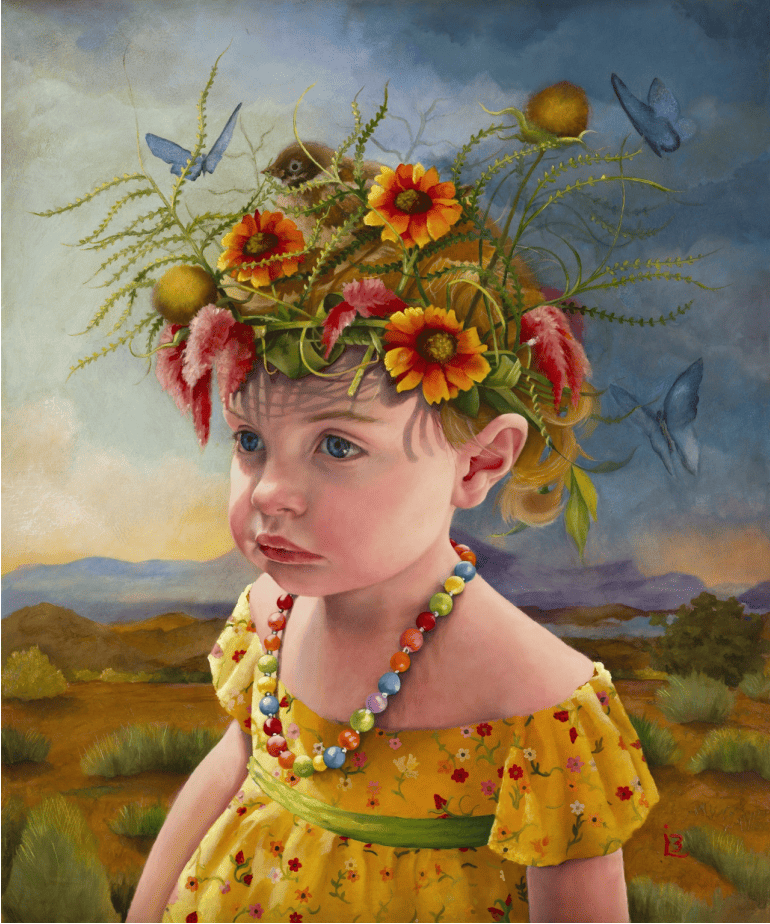
This professional evolution is visible directly in the paintings Mason has produced since returning to independent practice. RIP ICE, a 2026 oil on panel made in response to the shooting of Renee Good, shows two grinning, blindfolded devils pulling a hood over a seated woman, her skin painted chalky and uneven so she resists a specific racial or personal identity. Esparza, Nadine and the Beautiful Wall responds to the wall built between Mexico and the United States, replacing it with an invented wall of cakes built by two young girls to keep out trolls, watched over by a small figure of Pinocchio. Flight addresses environmental uncertainty through a single young girl standing alone in a barren landscape, asking what kind of world is being left to the next generation.
A Career That Circles Back on Itself
Looked at as a full arc, Mason’s career doesn’t read as a rejection of her earlier commercial work so much as a redirection of the same underlying skills, visual storytelling, compositional clarity, the ability to hold attention- toward subjects and a technique she chose entirely for herself. The editorial instincts formed at RISD and sharpened over years of commercial illustration are still visible in how effectively her paintings communicate. What’s changed is who those instincts now serve: not a publication, not a licensing partner, but Mason’s own sustained curiosity about the world she’s chosen to paint.
Discover Lib Mason’s original oil paintings at libmasonartist.com
and follow @libmason5687 on Instagram for behind-the-scenes studio updates.
