

Bianca Biji paints without a plan, and she does so deliberately. Born in Cluj-Napoca, Romania, in 1970, she does not normally make sketches or detailed projects before she begins. What she brings to the canvas is a willingness to let the first gesture of colour decide what follows. In her hands, a painting is less a stage for a prepared idea than a place where an idea may or may not arrive.
Formation Between Two Countries
She began drawing and painting at the age of three, an early start that makes her later decisions look like continuations rather than departures. From roughly the age of twelve to nineteen she attended an art school with a focus on graphics, years spent in the discipline of line and mark. At twenty she moved to Brussels, Belgium, and went on to study etching for five years at La Cambre, where she received distinction from the jury.
Etching is a medium of delay and indirection. The image is incised, bitten, inked and printed, and the result is never quite seen until the plate has done its work. It is tempting to read her later painting as a reaction to that structure, a turn toward immediacy after years of mediated, exacting craft. That is interpretation, not biography, but the contrast is suggestive.
Letting Colour Lead
In Biji’s account of her own method, colour takes control. She does not decide in advance what a painting will be; she responds to what the paint is already doing. As shapes appear on the surface she tries to read them, much as one might find a face in a stain on a wall, and sometimes those forms yield a message or an idea that she then follows. At other times she reverses the order, starting with a very free drawing and bringing in colour afterward.
Both routes share a refusal of the finished plan. The image is discovered rather than executed, which places the artist in an unusual position: she is the maker of the painting and also its first interpreter. The title comes last, only once the work is complete, so that naming becomes an act of recognition rather than direction.
A Private Room Without Compromise
Biji creates primarily for psychological sanity and for joy. She describes creation as a private space in which compromise does not exist, and she does not make work specifically to satisfy galleries. In a field where an artist’s output is so often shaped by anticipated reception, this stance is a quiet form of independence. It does not reject exhibition; her record shows plenty of it. It simply places the origin of the work elsewhere, in a need that exists before and apart from any audience.
This helps explain why the paintings can be spontaneous without being careless. The stakes are personal rather than commercial, and the freedom of that arrangement allows risk, including the risk of failure.
Tearing, Taping, Rebuilding
Failure, in fact, becomes material. Biji takes pieces from paintings she no longer likes, tears or cuts them into fragments, and joins those fragments with different kinds of tape. Sometimes she later glues the resulting composition onto a plain ground. She finds the activity playful.
The method rewards attention. A rejected canvas is not discarded but dismantled, and the dismantling is the first step of a new composition. One could say that the collages hold destruction and reconstruction in the same gesture, though that is a reading of the method and not a phrase she has supplied. The tape is a telling detail: it is a visible, provisional kind of joining, closer to improvisation than to repair. Her collage thinking mirrors her painting, since in both cases the next form depends on what the previous one has left behind.
A Record in Brussels and Vence
Her exhibition history, built across the late 1990s and 2000s, centres on Brussels and Vence in the south of France. In Brussels she has shown at venues including Galerie Art Pol, Espace Latitude, Galerie DS, the Théâtre de la Toison d’Or and the Gare de Watermael-Boitsfort, along with ateliers such as the Atelier de l’Escarpolette and Atelier Kasba. Atelier B in Vence and Galerie DS in Brussels appear as recurring presentations. Further afield in Belgium she has taken part in the Château de Seneffe and in artist trails (parcours d’artistes) in Boitsfort, Hoeilaart and Tervuren, as well as at Nero in Hoeilaart, Bulex in Brussels and Futurart.
Her work has also reached the page. In 1997 Éditions Tandem published her book “Détails de Guerre,” and she has contributed to collaborative editions including “Autoportraits,” “Carré Blanc” and “Gaspard, Melchior et Balthasar.” She also illustrated the children’s book “Orsolino.” Taken together, these projects suggest an artist at ease moving between the gallery wall, the shared edition and the illustrated story.
Three Paintings from 2026
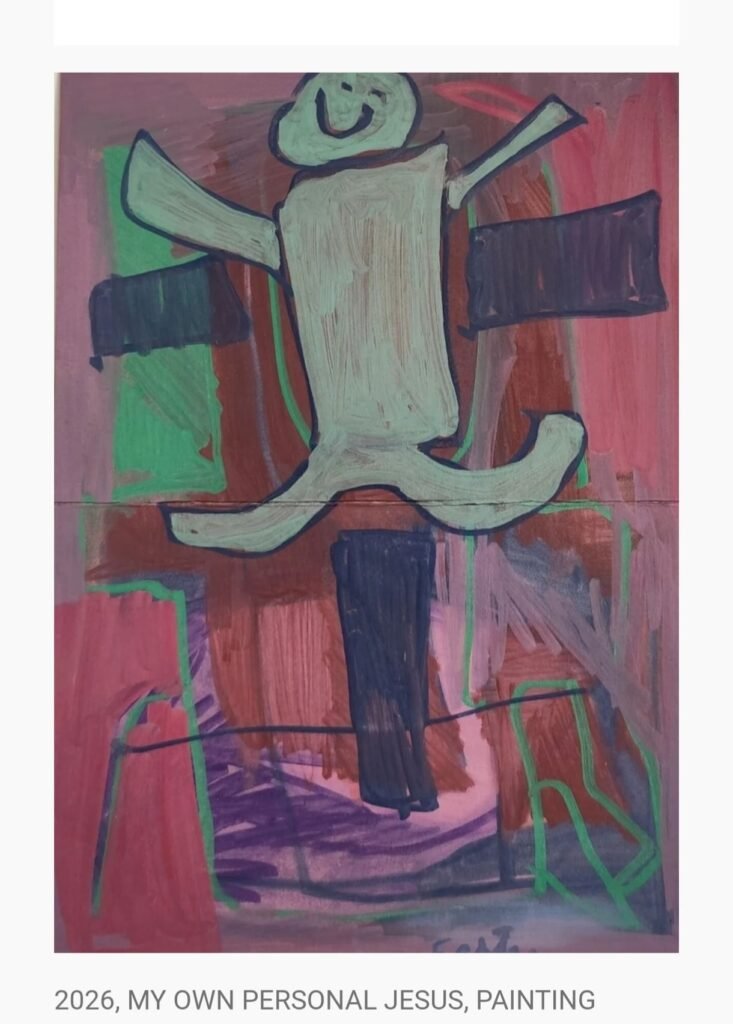
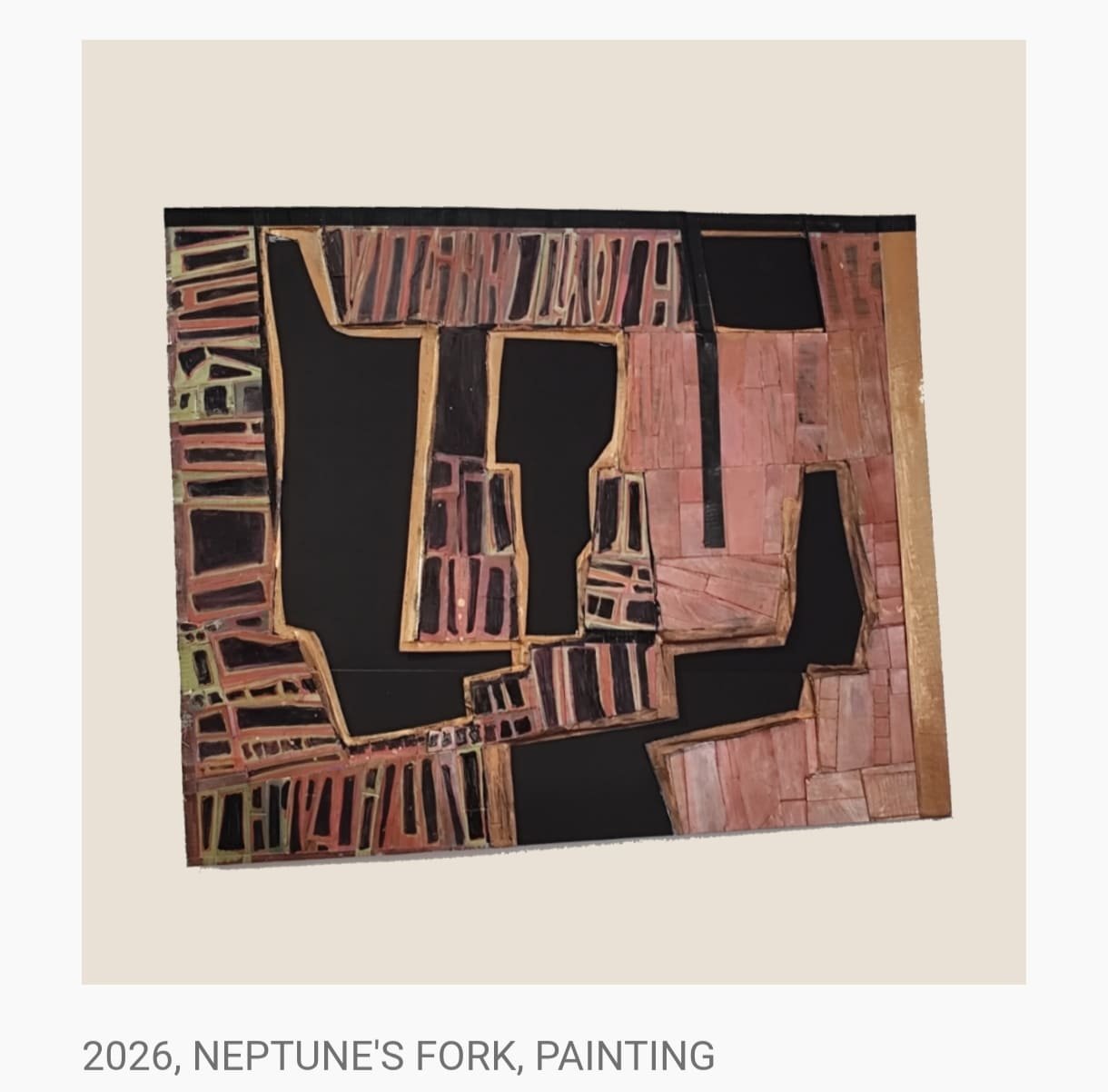
Her three paintings from 2026, “Neptune’s Fork,” “My Own Personal Jesus” and “Politician,” continue the method described above. No images or accounts of their content are offered here, and their meanings are not pinned down. What can be said is that, given her habit of naming a work only after it is finished, each title is likely a response to something that surfaced during painting rather than a subject set in advance.
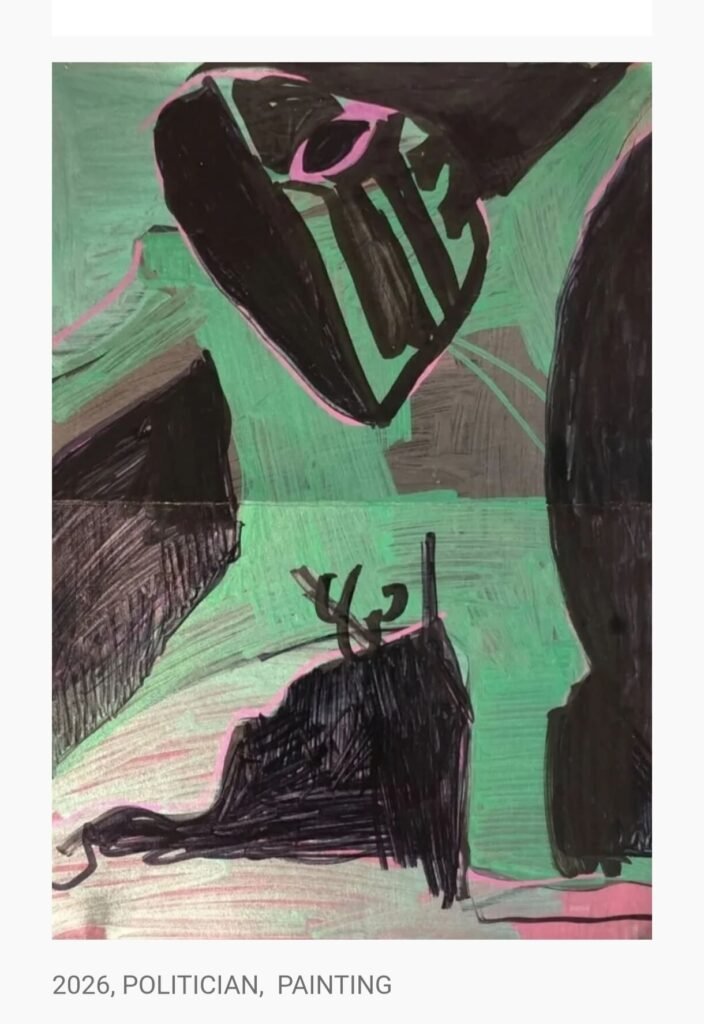
The titles themselves operate in different registers. One draws on mythology, another on devotion or pop-cultural irreverence, the third on public life. Whether those associations have any bearing on the images beneath is for Biji to say; as titles, they show an artist who allows her references to range widely and to land late.
An Artist Who Keeps Her Own Terms
What emerges from Biji’s career is consistency of attitude rather than of style. She trained rigorously, in graphics and in etching, and then built a way of working that relies on instinct, colour and chance. She tears up what disappoints her and builds again. She exhibits, publishes and collaborates, yet she keeps creation itself as a room with a locked door. In a period of constant demands on what art should be for, Bianca Biji paints for sanity and joy, and lets the work say whatever it ends up saying.
Discover More Works & Connect with Bianca Biji
To explore more of Bianca Biji’s available artworks, exhibition history, and recent series, visit her official portfolio and follow her studio practice online:
- Official Website: biancabiji.com
- Instagram: @biancabiji_
- Threads: @biancabiji_
