

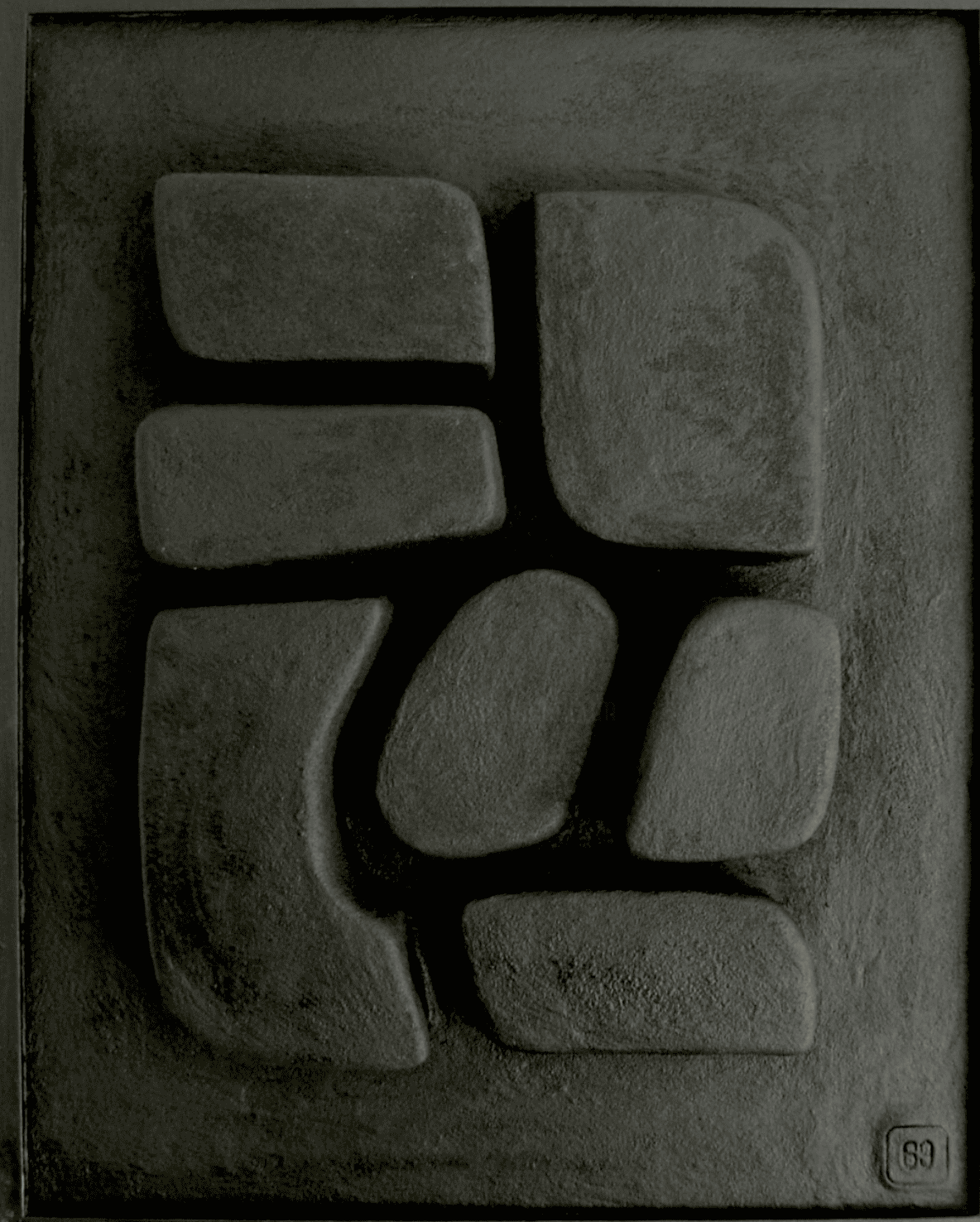
Zorya E Ordaz is a contemporary artist whose sculptural practice brings together cultural influences, historical references, unconventional materials, and a deep appreciation for the beauty of imperfection. Her works are created as contemporary wall sculptures that explore the relationship between form, texture, light, and shadow, resulting in pieces that continuously change depending on the time of day and the surrounding environment.
Inspired by diverse cultures and historical periods, Zorya develops compositions that exist somewhere between sculpture, design, and visual meditation. Her artworks are not intended to remain visually static. Instead, the interaction of light and shadow allows each piece to evolve throughout the day, revealing different dimensions, textures, and subtle variations as natural or artificial illumination changes.
At the heart of her practice is a belief in the value of slow, thoughtful creation. Described as “slow art,” her work reflects a meticulous process in which every piece is handcrafted from beginning to end. Her approach embraces imperfection, natural variation, and the passage of time, creating sculptures that feel connected to the principles of Wabi Sabi.
Inspired by Cultures and Historical Periods
Zorya E Ordaz’s artistic vision draws inspiration from the richness of diverse cultures and historical periods.
Rather than reproducing specific historical styles, she incorporates ideas and visual influences into a contemporary language of her own. Her work reflects an interest in how artistic traditions have evolved across different civilizations and how cultural ideas can continue to inspire new forms of expression.
This cultural dialogue gives her sculptures a sense of timelessness. While the works are distinctly contemporary, they also carry references to older traditions of craftsmanship, material experimentation, and decorative art.
Her goal is to create objects that can exist beyond a particular moment or trend. The sculptures are designed to feel relevant today while retaining qualities that allow them to transcend time.
The Dynamic Relationship Between Light and Shadow
Light and shadow are central to Zorya’s artistic practice.
Her wall sculptures are intentionally created with abstract forms that vary in shape, height, and depth. The uneven surfaces and changing elevations create opportunities for light to interact with the sculpture in constantly shifting ways.
As the sun moves across the sky, shadows can become longer or shorter. Different parts of the sculpture may become illuminated while others recede into darkness. Under artificial lighting, the same artwork can take on an entirely different appearance.
This means that the sculpture is never completely fixed.
The physical object remains the same, but its visual experience changes continuously. In this way, light becomes an active participant in the artwork rather than simply a means of illuminating it.
The relationship between light and shadow gives Zorya’s work a sense of movement and fluidity, despite the sculptures themselves being physically still.
The Philosophy of Slow Art
Zorya’s practice can be described as “slow art,” a philosophy that emphasizes patience, craftsmanship, and careful attention to the creative process.
Each piece is handcrafted by the artist from beginning to end. This approach stands in contrast to mass production, where objects can be quickly reproduced and standardized.
For Zorya, the time invested in making a sculpture becomes part of its identity.
The process allows her to respond intuitively to materials, textures, and forms as the work develops. Instead of forcing every element into perfect uniformity, she embraces subtle irregularities and variations.
This philosophy connects strongly with the Japanese aesthetic concept of Wabi Sabi, which finds beauty in imperfection, impermanence, and incompleteness.
Embracing the Wabi Sabi Aesthetic
Wabi Sabi is an important influence on Zorya’s approach to sculpture.
Rather than seeking flawless symmetry or industrial perfection, her works celebrate natural irregularities and the uniqueness of handmade objects.
The uneven heights and varied shapes of her wall sculptures are intentional. These differences allow the pieces to interact with light in unpredictable ways while also preserving a sense of movement and individuality.
The sculptures become reminders that beauty does not always depend on perfection.
Their surfaces may reveal subtle variations, textures, and imperfections that reflect the handmade process. These qualities give each piece its own character and ensure that no two works feel completely identical.
An Experimental Approach to Materials
Zorya E Ordaz’s material choices are among the most distinctive aspects of her practice.
She works with materials such as clay, cement, and paint, combining them with unexpected elements including coffee, salt, cinnamon, and crushed eyeshadow powder.
These unusual materials serve both practical and aesthetic purposes.
Some contribute to the structure and texture of the sculptures, while others introduce subtle tonal variations, surface effects, or shimmering qualities.
By incorporating everyday and unconventional substances into her work, Zorya challenges traditional ideas about what materials belong within contemporary sculpture.
Her process demonstrates that artistic potential can exist in unexpected places. Ordinary materials can be transformed through careful craftsmanship into objects of visual and conceptual significance.
Recycled and Natural Materials
Sustainability and material awareness are also present within Zorya’s artistic process.
She incorporates partly recycled materials into her sculptures, reflecting a conscious effort to reconsider how materials are used and transformed.
This approach aligns naturally with the broader philosophy of her work. By giving existing materials new life, she participates in a process of transformation and renewal.
Natural and recycled materials also contribute to the tactile qualities of her sculptures. Their individual characteristics become part of the final composition, reinforcing the idea that the material itself has a story.
The artwork therefore becomes more than a decorative object. It becomes a record of transformation.
A Subtle Connection to Kintsugi
The delicate iridescent shimmer found in some of Zorya’s sculptures recalls the visual philosophy associated with the Japanese Kintsugi technique.
Traditionally, Kintsugi involves repairing broken ceramics with lacquer mixed with precious materials, emphasizing rather than hiding the history of damage and repair.
While Zorya’s work is not simply a direct reproduction of this technique, the conceptual connection is significant.
Her use of shimmering materials suggests an appreciation for the idea that imperfection can become a source of beauty. Rather than concealing irregularities, the artistic process can highlight them and transform them into meaningful visual features.
This approach complements her interest in Wabi Sabi and reinforces the idea that age, change, and imperfection can contribute to an object’s character.
Sculptures That Change With Their Environment
One of the most compelling qualities of Zorya’s work is the relationship between the sculpture and its surroundings.
Because her compositions depend heavily on light and shadow, the environment becomes part of the artwork.
A sculpture placed in a room with strong natural sunlight may appear dramatically different from the same piece displayed under soft evening illumination. As the day progresses, the shadows shift, revealing new patterns and emphasizing different areas of the surface.
This creates an intimate relationship between the artwork and the space in which it exists.
The sculpture does not simply occupy the wall. It interacts with the room, responding visually to changes that are beyond the artist’s direct control.
Creating Contemporary Art That Transcends Time
Zorya E Ordaz seeks to create contemporary wall sculptures that can transcend temporary trends.
Her combination of cultural references, historical influences, natural materials, recycled elements, and contemporary abstraction allows her work to exist between different periods and artistic traditions.
The sculptures feel modern in their forms while carrying an underlying respect for ancient ideas about craftsmanship, imperfection, materiality, and transformation.
This balance gives her work a timeless quality.
Rather than creating objects that are defined only by the present moment, Zorya aims to produce pieces that can continue to evolve in the eyes of their viewers and within the spaces they inhabit.
The Beauty of Transformation
Ultimately, Zorya E Ordaz’s sculptures are explorations of transformation.
Materials are transformed into art. Ordinary substances become unexpected textures. Imperfections become aesthetic qualities. Light transforms surfaces, while shadows reshape the viewer’s perception of form.
Her work reminds us that nothing remains visually or materially fixed.
The changing light throughout the day, the natural qualities of the materials, and the handcrafted irregularities of each piece all contribute to an artistic language centered on impermanence.
Through her commitment to slow art, Wabi Sabi principles, unconventional materials, and dynamic relationships between light and shadow, Zorya creates sculptures that invite viewers to pause and observe.
Her works are not simply objects to be viewed once. They are evolving visual experiences that reveal something different with every shift in light.
In bringing together cultural inspiration, environmental awareness, experimental materials, and a sensitivity to the passage of time, Zorya E Ordaz offers a thoughtful contemporary approach to sculpture one that celebrates the imperfect, the handmade, and the ever-changing beauty of the world around us.
