

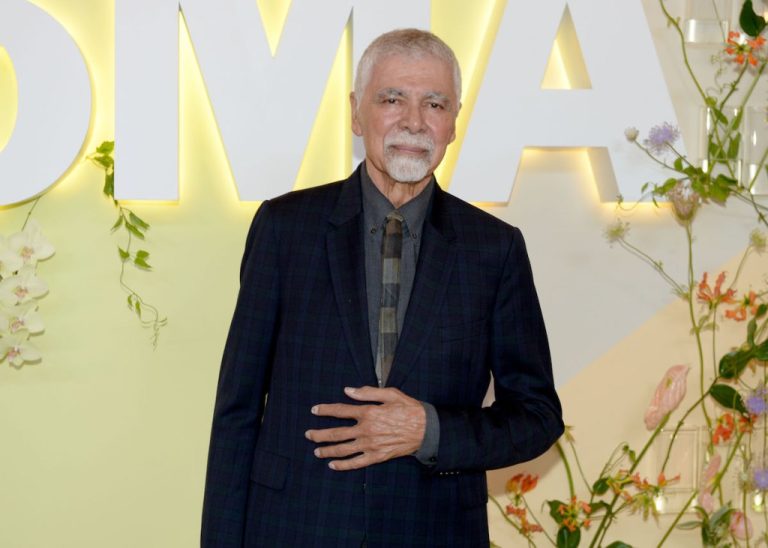
Ricardo Scofidio, an architect who helped reshape the museum landscape in the US, died on Thursday at 89. His death was announced by Diller Scofidio + Renfro, the firm he founded with his wife Elizabeth Diller in 1997.
Working alongside Diller and firm partner Charles Renfro, Scofidio worked on many US museum projects, from the Museum of Modern Art‘s 2019 expansion to a building for the Broad, the Los Angeles private museum of collectors Eli and Edythe Broad.
The firm’s various projects included any number of projects that were not museums: Lincoln Center, redesigned with new outdoor spaces at a cost of $1 billion; the High Line, the railroad viaduct–turned–park that runs through New York’s Chelsea neighborhood; the Blur, a pavilion situated in a Swiss lake; the Brasserie, a restaurant in the Seagram Building. But it is Diller Scofidio + Renfro’s museums that have had some of the greatest impact. (Though Scofidio was not the principal designer of all of them, he continued to play an active role in nearly all of them.)
The Institute of Contemporary Art Boston, the first US museum designed by Scofidio’s firm, offered a view of what the group would offer in future projects. Opened in 2006, the museum was, at the time, the first to be built in Boston in a century. It towers over the harbor nearby, with a hulking cantilevered form that juts out toward the water.
Diller Scofidio + Renfro’s ICA Boston is not without its quirks. Much of the art is confined to the building’s expansive fourth floor, leaving many portions of this sizable museum inaccessible to the public, and the lobby was labeled “an awkward leftover space” upon the building’s debut. But, even despite it all, the ICA Boston nailed down an aesthetic that Scofidio and his partners would popularize in the years to come: sleek but not too sleek, with heavy, minimalist forms that do not feel austere.

Perhaps for that reason, Scofidio, who won a MacArthur “genius” grant alongside Diller in 1999, becoming the first architects ever to do so, was sometimes even treated as an artist in his own right. His firm’s work was the subject of a survey at the Whitney Museum in 2003. Last year, at the MAXXI museum in Rome, Diller Scofidio + Renfro mounted a show called called “Restless Architecture.” In that exhibition’s description, the firm asked: “In light of the fast pace of change all around us, why should architecture sit still?”
Ricardo Scofidio was born in 1935. His father was a Black jazz musician who, according to Scofidio, insisted that he was Italian; his mother was “light-skinned,” as Scofidio once recalled, but was “actually half Black.” “I was continually told as a child to be invisible,” Scofidio told the New York Times Magazine.
But his career as a leading architect would ensure that he would not remain that way. He studied architecture at both Cooper Union and Columbia University. He began teaching at Cooper Union in 1965, where he would eventually meet Diller, who was a student of his. They would cofound their firm in 1979 and marry in 1989. (Diller was his second wife, after Allana Jeanne De Serio.)
Scofidio and Diller were by considered important figures within the field of architecture by the start of the new millennium. They were renowned for mapping overlaps between architecture and the fields of fashion, theory, and more. But the ICA cemented their status as two of the go-to architects for museums seeking to redesign or expand.
A slew of museum projects followed the ICA: a renovation for the Berkeley Art Museum and Pacific Film Archive, a new building for the Victoria & Albert Museum in London, a planned expansion for the Art Gallery of Nova Scotia in Canada.

Not everyone loved all of their creations. The Broad, the museum Diller Scofidio + Renfro designed in LA, has proven particularly divisive, with many poking fun at its honeycombed exterior made of steel. “The good news is that the museum’s exterior and main exhibition space hold their own,” wrote Sarah Williams Goldhagen in Art in America upon its opening in 2015. “But overall the Broad is a disappointment, and the ways in which it fails are more than a little concerning. Its incoherence, its poor urbanism and its unoriginality suggest that the transition from critics to makers may have DS + R stumped.”
The firm’s $450 million MoMA expansion, which opened in 2019, has been more universally praised. It seamlessly added 47,000 square feet of gallery space to the museum, whose programming was suddenly able to grow even more ambitious than it was in the past.
At that same museum, 30 years earlier, Diller and Scofidio took part in MoMA’s famed “Projects” series, which has acted as a launching pad for artists, many of whom are at the start of their careers. They debuted a piece called para-site, in which cameras and hanging chairs were placed around MoMA. The feeds from the cameras could be viewed in the sculpture garden, where visitors may get unusual angles of spaces they knew well. It acted as a mission statement for what Scofidio would later seek to do: alter the way people saw museums.
