


Alexandra Jicol doesn’t chase trends. Her art is personal, introspective, and raw in a way that invites you to slow down. She doesn’t pretend to have all the answers. Instead, she walks alongside the viewer observing, feeling, and asking questions. Born and raised in Bucharest, Romania, Jicol came of age during a time of political tension and limited freedoms. That early experience shaped how she looks at the world with care, curiosity, and restraint. It also explains her deep sensitivity to nuance. Rather than painting for spectacle, she paints to reflect. Her work isn’t decorative. It’s an invitation to listen.
Her ongoing relationship with the human condition its joys, anxieties, flaws, and beauty drives the direction of her work. Jicol’s goal isn’t to resolve complexity but to hold space for it. Through the language of color, form, and material, she builds pieces that speak without shouting. Her art is direct, quiet, and honest. Like her.
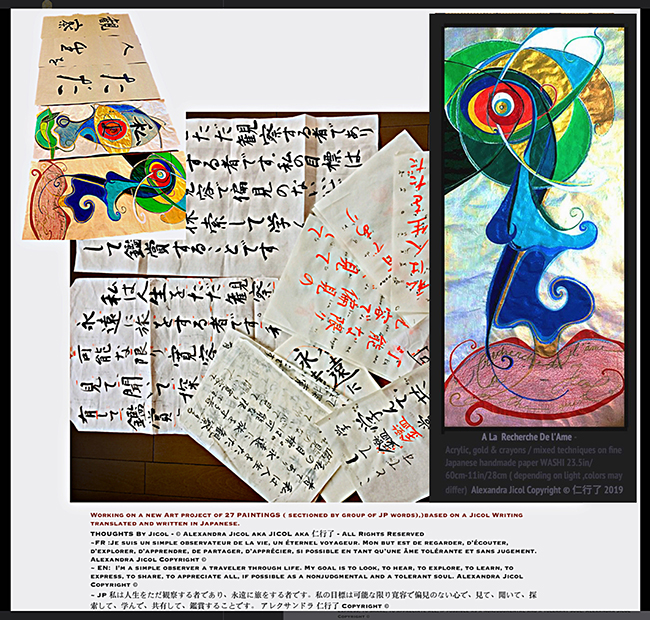
Her project, Autour Du Monde, De La Source, De Retour A La Source (“Around The World, From The Source, Back To The Source”), is as much a statement as it is a gesture. In it, Jicol worked with 28 Japanese words translated from her own poetic thoughts each becoming a separate painting. The materials are modest but intentional: fine Japanese handmade washi paper, layered with acrylic, gold, and crayon. She doesn’t hide the hand. You see the energy of the gesture in each mark.
The titles are symbols, not explanations. They are written in kanji and hiragana, lifted from a statement she originally wrote in French and English:
“I am a simple observer, a traveler through life. My goal is to look, to hear, to explore, to learn, to express, to share, to appreciate all, if possible as a nonjudgmental and tolerant soul.”
That’s the heartbeat of the project. Each painting offers a moment one word, one feeling captured without decoration or agenda. It’s a slow practice. Five months of preparation. Hours spent making room for silence. Each piece leans into minimalism without becoming empty. The colors are bold but not aggressive. The forms are simple but not naive.
There are faces, yes, but they don’t belong to anyone specific. Sometimes they dissolve into lines or break apart entirely. At other times, all that remains is a single eye, floating in space. She returns to this symbol again and again—not just the eye as a shape, but as a question: who is seeing? What are we seeing? What do we refuse to see?
Lines fracture and reconnect. There is beauty in that tension. And within that tension is play—color that jumps out from the page, shapes that flirt with being symbols but stop just short. There is humor, too, even in a project this reflective. A teasing mark here, a crooked smile there. Jicol isn’t afraid to let emotion peek through the surface. It’s what gives the work breath.
The use of gold not flashy, but thoughtful adds a spiritual shimmer to the pieces. It’s not about wealth. It’s about essence. That invisible thread that might link us all. And that question lingers throughout the project: Is there something left after we’re gone? The soul, the trace, the whisper. Is there a return to something? Or is it just a quiet fade?
This project doesn’t attempt to answer. Instead, it gently points to the possibility of meaning. And that might be enough.
Jicol trusts her viewer. She doesn’t over-explain. She doesn’t guide you toward a single conclusion. The work is finished, but the meaning isn’t fixed. That’s part of the process. “I just let my art speak,” she writes. “Hoping that it will to the right passerby who will instinctively decode the message.”
And that’s really it. Her paintings wait. Not passively, but patiently. They’re not trying to be loud. They’re waiting for someone who is ready to look and to feel.
